
eXtensions - Sunday 15 February 2025
By Graham K. Rogers
Apple released OS 27.3 updates this week and some clever analysts identified new M5 chips. These appear to be Pro and Max or both. More excited reports about allegedly imminent hardware releases appeared with some hedging their bets for March. Google is investing in Bangkok to support Thailand's cloud economy. Bangkok has a history with large US corporations. When the Internet works, no one notices. When it stops, disaster. Causes range from power cuts, road accidents and anchor-dragging, to squirrels and woodpeckers.
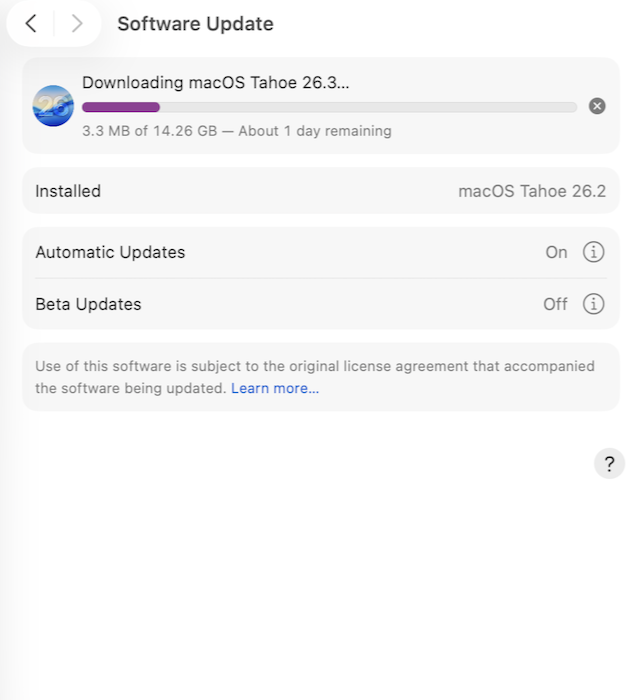
As had been expected, there were updates to all of Apple's operating systems this week. They arrived Wednesday morning, here, and seemed reluctant to appear in the various download panels on my devices. The iPhone was first and that took a while before I could click on the download button and enter my passcode. I was wary of the iPad Pro as that had failed to recognize an update last year. I ended up wiping the device and starting afresh. Since then I have had no other download problems. The Watch is always slow, but I noticed that updates to apps were also being delayed on the iPad and iPhone. With one set of app updates on the iPad Pro, there was a pause of several seconds before the circular progress bars began to change from grey to blue. I was not sure if this was a problem at Apple's end, with so many users updating around the same time. I now think this may have been a more local problem (see below).

|
|

|
Reports about the imminent OS 26.3 identified that M5 pro and M5 Max chips are probably on the way. Ben Lovejoy (9to5Mac) suggested that this was a little more complex than we may have first thought, as the Pro and Max chips are "variants of the same one", but Apple is using some clever engineering. They are able to create chips which have all the features of both (Pro and Max), but when they are installed the settings ensure that one or the other is used not both. As Lovejoy reports we would soon be able to identify if this is being used by Apple with a tear down. I wonder if anyone will try and engineer a Max out of a Pro? I am sure Apple has thought of that.

Several sites are reporting that Apple could be releasing new hardware soon, particularly with the shortages now reported in certain mac models and the iPhone 16e. The iPhone 17e is said to be on the way. Further to reports on delays, Ryan Christoffel (9to5Mac) writes that delays for the Mac Studio have extended on Apple's online ordering site and are now extending to April. He writes that it is "unclear whether the current shortages are due to an imminent refresh, or because of current industry-wide memory shortages. . ." but with delays this severe, it looks more like a clearing of the decks. However, William Gallagher and Mike Wuerthele warn that such shortages may not be a reliable indicator. They concede that "it could be true" but (I agree) maybe not. There are many other supply factors in play right now.
At Computer Weekly,
Aaron Tan reports on Google's investment in the Bangkok cloud region which will support "Thailand's digital economy by offering local data residency, low-latency connectivity, and direct access to Google's suite of artificial intelligence (AI) tools." One important point is that the system will process and store data within the country's borders. This should "remove barriers to entry for regulated industries, including the public sector, healthcare and financial services." Local companies are working with Google to ensure compliance and connectivity.
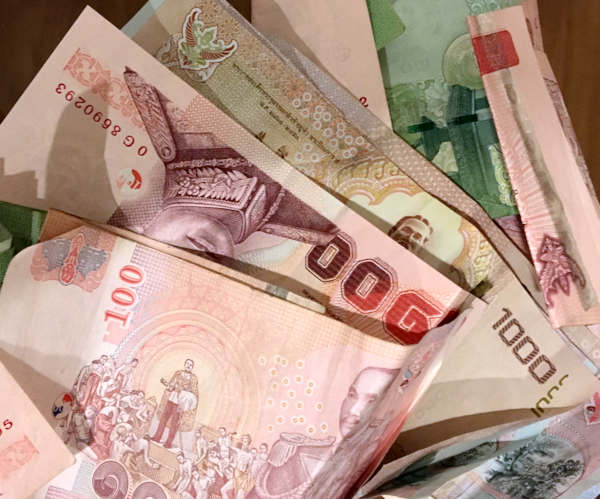 This is a far cry from the early days of computing here. It was almost impossible to buy legitimate software within the country, and if this were ordered from outside, the moment an address in Thailand was given, the order was stopped. No wonder a huge pirate software industry was created here. There was little interest at the time from software companies, although the hardware was available - I remember my first sight of Silicon Graphics machines at a computer show here. I was lucky that the Faculty later bought some of these and I was able to teach basic UNIX skills with them.
Apple did have a thin presence here, and was mainly represented by independent companies that carried out functions for them. Apart from an occasional show, for example when the original iMacs appeared (at the old Siam Intercontinental Hotel - now Siam Paragon), there were only a few independent retailers. The iMacs and the iBooks were the beginning of change. Microsoft had been almost totally hidden to ordinary users, but there was a slight thaw when MS DOS 5 was released (Dave Brubeck famously performed Take Five at the US introduction). In Thailand it was different and at a meeting held in the Hilton Hotel, an executive from the company outlined the details of a plan: knowing that most users had pirated versions of DOS, Microsoft would supply update disks with version 5.0 for 500 baht. I thought that was a good deal and signed up right away, later buying the update to MS-DOS 6. Then I switched to Macs.
I am unlikely to use this new cloud-based service, but Google has connected with the local community here on a number of occasions in the past. There was an education program a few years ago with USAID which used our university as its core. A group of educators would teach students computer related skills. The program operated in Thailand and later in other SE Asian countries. Initially, Chrome Books were used. To operate those, an internet connection was needed and a Google account. Internet access was often a problem, but the idea worked. I noted that, if this was region-wide, Google would be collecting data from thousands of students. They would later grow up to become consumers of course. That point fell a bit flat I am afraid. In the end, with politics playing a part, the USAID program separated from Google and eventually the program fizzled out, although I am sure some youngsters were stimulated by it.
After making a presentation to students on writing project proposals on Wednesday, then discussing with each group their outlines, most of which had to be done again, I went home. As I had promised the students, I updated the slides to match a couple of changes I had made during the presentation, then uploaded a PDF to my site. I sent the link to the group, but there were problems sending the messages. And a follow-up message was not sent initially. A message appeared on the iPhone that suggested my Airport router (I am still using that at home) was not linked. When I checked the devices, the internet provider router was showing a red light.
 I restarted all the devices, but that did not make any difference. The answer came in a message from the IP: the connection was not available "due to fiber optic difficulties" and should be back by 20:00. These messages from AIS are useful - they help users to plan, and limit frustration. At least you know the cause and that someone is working on a fix. The messages from the company usually err on the side of pessimism as the power or internet connections are often returned before the time stated. This week, I had the internet back by 19:00, but by then I had already reworked my evening.
In any country there are sometimes problems with the physical cables that connect power, telephone or fiber-optic systems. Internationally, the submarine cables that keep the world connected have recently suffered several cuts, particularly in northern waters that some suggest have been made deliberately by ships dragging their anchors. Sometimes these cuts are through road accidents. Many power lines and telephone cables are still above ground here. A heavy truck can bring down several power line supports and that can mean hours of work for the teams who replace them in all weathers.
A few years ago I lived in a house that had many trees. Not only was there a certain beauty, but my house was far cooler, even without air-conditioning. The lines that brought my internet needed replacement fairly frequently because squirrels would gnaw through them. This week, a report from Conor Pope (Irish Times) reveals that the town of Sixmilebridge, in County Cork, has suffered 11 power outages from woodpeckers in the last year. The one shown here was a new year's day visitor way outside its normal territory.
Unlike the squirrels that attacked my cables, the woodpeckers bore into the poles, weakening them. The report notes that this is a relatively new phenomenon as these birds were previously in Scandinavia. Climate change reduced their food sources, so they moved to Ireland. The engineers are hoping that composite poles will be less attractive to the woodpeckers.
Graham K. Rogers teaches at the Faculty of Engineering, Mahidol University in Thailand. He wrote in the Bangkok Post, Database supplement on IT subjects. For the last seven years of Database he wrote a column on Apple and Macs. After 3 years writing a column in the Life supplement, he is now no longer associated with the Bangkok Post. He can be followed on X (@extensions_th). The RSS feed for the articles is http://www.extensions.in.th/ext_link.xml - copy and paste into your feed reader. No AI was used in writing this item.

For further information, e-mail to
Back to
eXtensions
Back to
Home Page