
eXtensions - Friday 19 December 2025
By Graham K. Rogers
Rumors about Macs coming next year look intriguing. External storage is always worth a thought: future developments and options. TV comments. Risks with AI-generated content: writing and code. A look at some well-balanced writing from English judges.
We are unlikely to see any hardware releases from Apple this month, but there are some expectations for the new year. A recent rumor, which has some sound technical support, suggests that Apple has been testing an iMac with the M5 Max chip (Hartley Charlton, MacRumors). That would be quite a machine, and as Ryan Christoffel in outlining the details gleaned from online logs, uses "might be coming" in his report. Roman Loyola (MacWorld) notes several past rumors on such models, but seems to think that this is a test model rather than one destined for sale. There has not been a 27" iMac Pro since 2021. I have been expecting the iMac to be updated for a while. The current 24" version with the M4 chip was released in November 2024. Oliver Haslam (Redmond Pie) writes as if this a sure release. Others are less convinced. It does seem like a good idea.
We have also heard several rumors in the last few months about a lower-priced Mac sporting the A18 chip. This sounds like an entry-level model, so one would not expect super graphics (or screens), but this would run some of the basic applications. This would be useful, perhaps, for those who do not need high level processing abilities and could open the platform up to more users. Related to this Hartley Charlton (MacRumors) reports that, like that M5 Max iMac, references in some logs have been seen to a Mac with an A15 chip. A chip that was first available some 5 years ago. The article suggests that this was a test device - a proof of concept - in much the same way as Apple ran Intel chips in Macs for a few years before the move to Intel because of poor cooling results from the PowerPC G5 making it unsuitable for a notebook computer.
In a recent article on Tom's Hardware, Luke James outlines a new glass data storage medium that has been developed by a startup called SPhotonix. It can apparently store up to 360TB of data, for up to 13.8 billion years. I guess that may be enough time for a new civilization to emerge after we have destroyed the planet. A problem with the fused silica glass material seems to be with the reader, which is specific for the type of medium and is estimated to cost some $6,000. A writer - these use laser technology to etch the data on (or is that "in") the glass - is quoted as $30,000 currently. The platters are read only (write once) and would therefore be used for long-term storage of massive amounts of data. With any such technological development, the early costs would reduce if the new system were to be taken up.
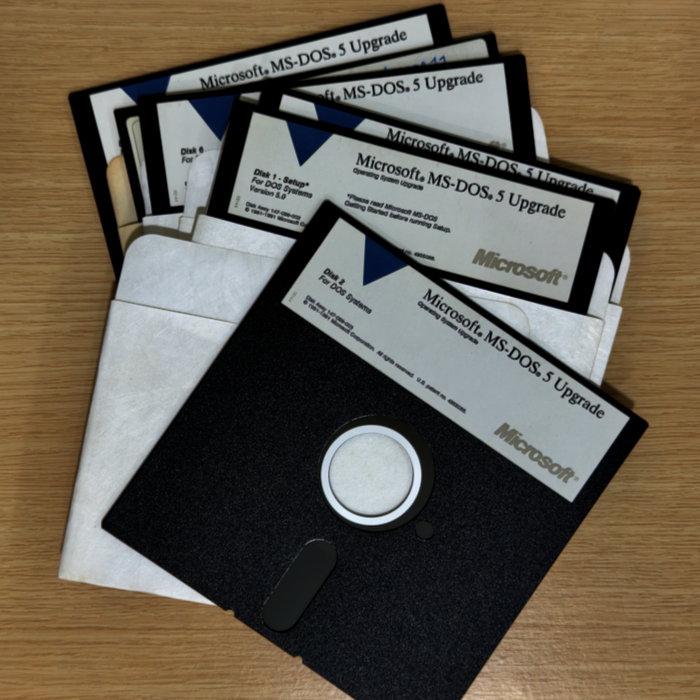
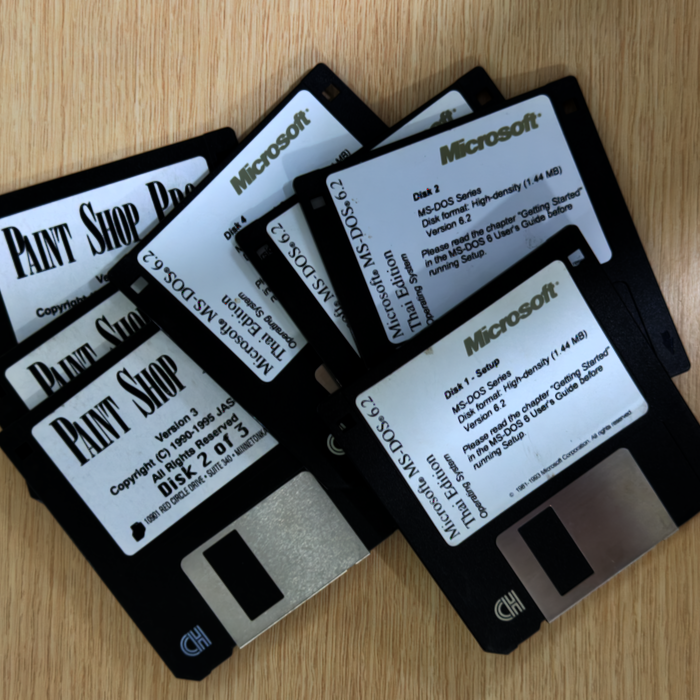
Sony came up with the 3.5" floppy disk in 1981 and the standard was finalized the following year. I first used a personal computer (Zenith) in 1985 and that ran on twin 5.25" floppy disks. These had superseded the 8" disk. An early Macintosh did arrive in the department that same year and that of course had the newer disks. These are still used in some places and I do have examples of both (oddly enough MS-DOS update disks).
|
|
As optical media systems began to appear in the 1990s, there were a number of proprietary solutions to the problem of data storage for companies (and others). It was a real problem then, with the large laser disks being read only, and too large for office or home use as a storage medium. The smaller 3.5" or 5.25" floppy disks would need too many to store even a basic program. It took 6 x 5.25" disks for the MS-DOS 5.0 update; and even a relatively small application could use several disks. The arrival of the sensibly-sized CD-ROM and later the DVD solved several problems at once: with size, capacity, and low-priced read/write systems for home and office. The accessible optical disk saw the end to those proprietary solutions and reduced floppy disk use. At the end of the article are images of and links to other data storage solutions: some stiff competition.
In a related article Mike Wuerthele & Malcolm Owen have a good look at external storage for Macs. This useful reference article covers drives and enclosures, taking in cloud storage, hard drives and SSDs, caches, drive categories, reading and writing data, DAS, RAID and NAS, among other relevant information, including connectors. The writers also look at a selection of drives.
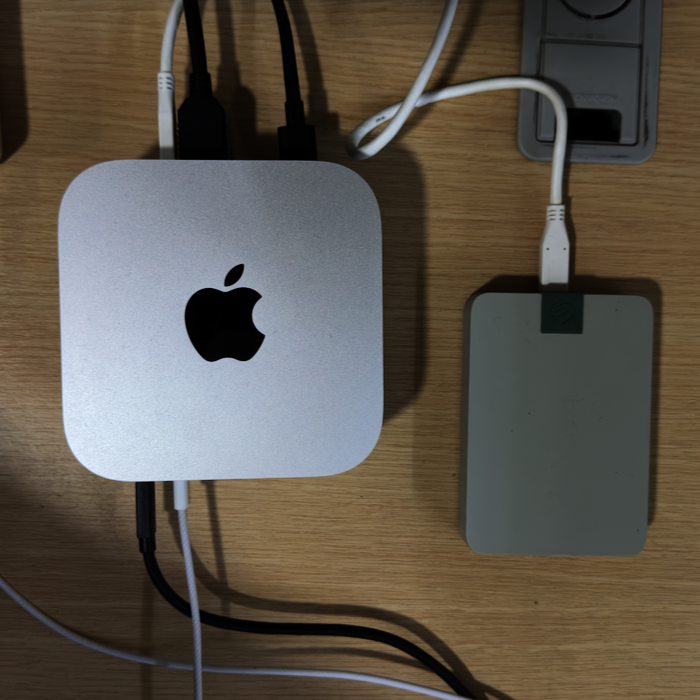
I have a mix of hard drives, for backup and storage, including a couple of 5TB Seagate drives. Most of my external storage - hard disk and SSD - is 2TB, which is a convenient size and price range. I did buy a Samsung T7 disk for the iPhone as this has higher read and write speeds: "up to 1,050 MB/s and 1,000 MB/s" according to Samsung. I use this with a Thunderbolt 4 cable and this combination allows me to record ProRes 4k video at 60fps or higher.

|
|
I finally managed to watch Apple's much-hyped F1 movie this weekend and in some ways was quite impressed. I have been a fan of Grand Prix racing since the engines were in the front, so like many others have opinions on this. As a movie, it works well, with one or two weak points: minor plot problems; technical questions. The filming was superb and it was easy to become lost in the visual presentation. The racing was more realistic than the previous gold standard: John Frankenheimer's Grand Prix (1966). Camera technology has advanced considerably since then; and it has been widely reported that Apple developed special cameras based on iPhone technology, specifically for this movie (Hartley Charlton (MacRumors) and others).
Last week saw the final episode of Down Cemetery Road and it was revealed that there is to be a Season 2, although I am at a loss to explain why the article by Ryan Christoffel (9to5Mac) failed to mention the name of the show in the headline: "Hit Apple TV thriller from Slow Horses author lands new season". That is going for hits rather than providing readers with good information. Once the page is accessed, one-third of the way down there is more headline-sized text: "Down Cemetery Road gets season 2, with star duo returning". That looks as if a sub-editor changed that and left the original in the content.

I admit I have a love for science fiction: movies, novels, comics (when younger). There has also been some excellent music inspired by SF themes, from Jeff Wayne's War of the Worlds (1978) to Interstellar (Hans Zimmer) and the compositions of John Williams, like Star Wars, Indiana Jones, and E.T the extra-Terrestrial. That last was for a movie by Steven Spielberg, who has kept me entertained through several movies: Schindler's List, Minority Report (2002), War of the Worlds (2005), Ready Player One and many more. It is reported this week, by Benjamin Lee (Guardian) and others, that a new movie from Spielberg, a UFO movie with a pretty full cast list, is to appear in the summer of 2026. There is however, a link to a trailer for Disclosure Day in the article. What is shown reminded me in some ways of the compelling Knowing (2009), with Nicholas Cage.
The Guardian review mentions several top names - Emily Blunt, Josh O'Connor, Colin Firth, Colman Domingo, Eve Hewson and Wyatt Russell. Lee writes that the publicity and trailer release for Disclosure Day has coincided with the success of hit documentary documentary, The Age of Disclosure, "which alleged a government cover-up over the existence of alien life."
We recently saw a portrayal of evil by Matthew Rhys on Netflix in The Beast in Me. He would switch in an instant between humor, ridicule, anger, and murderous. The series also starred Claire Danes, who gave one of her edge-of-paranoia performances. Ryan Christoffel (9to5Mac) reports that Rhys is to star in a new series on AppleTV, described as comedic horror. Widow's Bay will be available from 29 April, initially with the first 3 episodes, then one a week.
I fret almost daily about AI-generated content from students and some academics who all think that they are being given a free go: that the content they produce is excellent English. It really isn't. They lack the experience to see that the word salads they are being fed by AI are not premium content. The word choice is weak and many words are unnecessarily multisyllabic: why choose a short word when a long one looks much smarter? Sometimes the AI presents the wrong word - it does not mean what they think it does and they do not check. Sentences are wieldy: too many words. Worse: the output does not have the musical or poetic rhythms that well-written English possesses. You should hear the sounds of the words as they move across the page (or screen, these days).
As an example, when I went to the USA in the mid-1980s, my Latin teacher (yes, really) commented one day that I was the first person he had ever known who used "shall" correctly. It was just how it was, I never learned this in a lesson as far as I can remember. It was natural for me. In the light of my comments on listening to the words I thought about how this was used. The song, "We shall not, we shall not be moved. . . " came to mind. Wikipedia notes that this is sometimes, "I shall not be moved". It occurred to me that were the "shall" replaced with "will", the refrain would sound different. It would mean the same, but would not have the force of the original. It is that type of fine difference that I see when I am looking at AI-written content.
I had also thought about the way this AI incursion could affect coding. I had read several reports on how this was making it easier, how coders were being laid off, and how there were also reports on problems with this new content. There were stories about the coding in the latest version of Windows, and we note that Microsoft is backing off some claims. I spoke to the head of the Computer Engineering Department here who made similar observations to those I have been making on writing: generic output, errors, students losing skills. Who will be able to check the code in the future if all output is produced by AI?
I am not alone, as an article in MIT Technology Review, by Edd Gent voices similar concerns from those who are responsible for producing output. He writes, "For some developers . . . initial enthusiasm is waning as they bump up against the technology's limitations. . . . [R]esearch suggests that . . . productivity gains may be illusory . . . some are questioning whether the emperor is wearing any clothes." And (like I have found with AI writing output) "because the code they output looks so polished, errors can be difficult to detect". These quotes do not do the article justice and I recommend reading this. In the context of this article, Katie Drummond (Wired - Paywall) reports on an interview with Matt Garman (head of Amazon Web Services) who thinks that AI should not replace junior developers: "a nonstarter for anyone who's trying to build a long-term company."
 Note also the comments from Tilly Harris & Rhys Blakely (The Times) on fake citations and references found in a Springer guide to ethics intended for writers of articles. The problem of non-existent articles or false references is something I have seen a number of times in the last 3 or 4 years. This was rarely a problem before AI became widespread.
While I was looking at AI-related warnings, on Wednesday morning I saw an unsettling tale from Matthew Gault on 404 Media. I read this in the daily newsletter which looks at a range of security and privacy concerns. It is irrelevant that this concerns a gay gamers discussion group. It might have been any closed community wishing to chat about events and ideas. A moderator, Jason Clinton, who is an executive of Anthropic, inserted a version of the Claude chatbot into a Discord server despite members' wishes.
The timeline and some of the messaging are included in the posting. Over-riding the wishes of members - who are leaving the group in droves - is disturbing in itself, but what I find is even more concerning is the way Clinton discusses the chatbot, as if it has a personality and feelings. Clinton refers to Clawd (the version of Claude) as "He" as the actions of the chatbot are described.
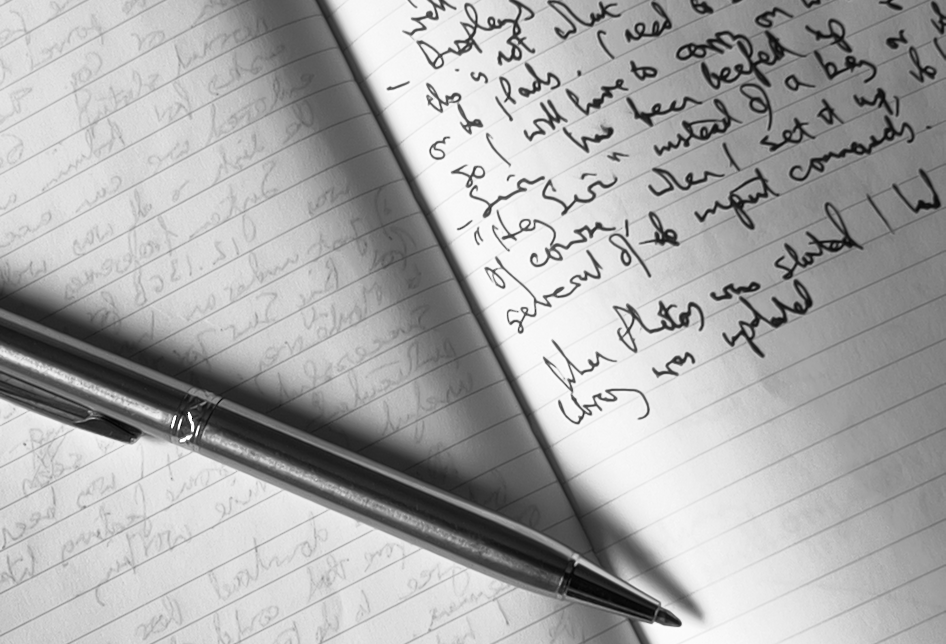
Once in a while, I read a judgment from the English courts. It reminds me of days when I gave evidence, and I particularly remember facing Judge Robert Lymbury whose obituary in the Times begins, "Best known for the meticulous fairness he brought to his courtroom, Bob Lymbery was a gentleman judge in the truest English tradition." There was no pulling the wool over his eyes: he could detect a falsehood instantly. I was fascinated by the way he wrote everything in longhand in the huge book he had; and when it came to his summing up, he quoted accurately what witnesses, and defendants had said. A lesson in thoroughness.
The other point that has me going back to these judgements is the clarity of the English: no academic puffery here; just clear comments that make the path to the court's decision completely understandable. In the judgement I read this week, an orthopedic surgeon was being sued by a former professional footballer (Blake v Calder) because it was claimed the treatment had caused a worse outcome than was expected (I am simplifying this). After summarizing the evidence from different expert witnesses, some of whom gave testimony which differed, the judge, Mrs Justice Lambert, came to the Discussion (para 77 of 134). It was clear to me by the 3rd sentence of para 78 that the defendant had lost, but the language used is so subtle that this could easily be missed. Much of the rest laid it on much thicker.
Good judgements, good writing are not accidental. They come from a careful balancing of the information available, and setting that out in as clear a manner as possible.
Graham K. Rogers teaches at the Faculty of Engineering, Mahidol University in Thailand. He wrote in the Bangkok Post, Database supplement on IT subjects. For the last seven years of Database he wrote a column on Apple and Macs. After 3 years writing a column in the Life supplement, he is now no longer associated with the Bangkok Post. He can be followed on X (@extensions_th). The RSS feed for the articles is http://www.extensions.in.th/ext_link.xml - copy and paste into your feed reader. No AI was used in writing this item.

For further information, e-mail to
Back to
eXtensions
Back to
Home Page